Peer Review Process
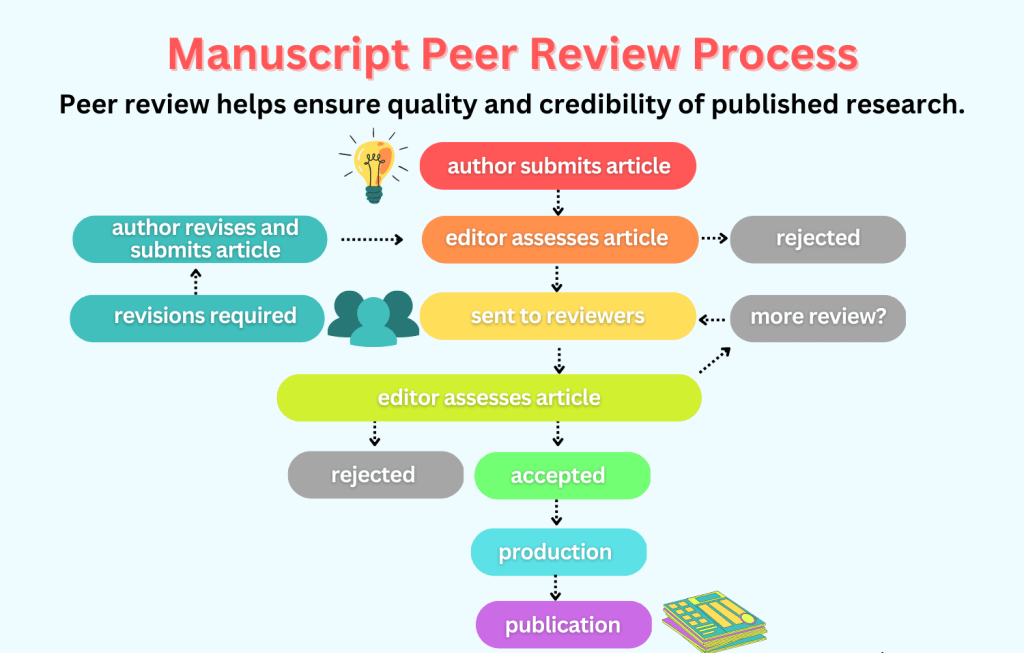
We normally use Double -blind peer review process. Double-blind peer review is a scholarly publishing process where neither the authors nor the reviewers know each other's identities, aiming to minimize bias by focusing solely on the manuscript's content, not the author's reputation or affiliation. Authors must anonymize their work by removing names, affiliations, and self-referential phrases, while reviewers remain anonymous to the authors, ensuring a fairer assessment based on the research quality.
Peer Review Process – IJPMSR
The International Journal of Project Management Studies and Research (IJPMSR) follows a rigorous double-blind peer review process to ensure the quality, integrity, and academic value of all published articles. The identities of both authors and reviewers are kept confidential throughout the review process.
Step 1: Manuscript Submission
-
Authors submit their manuscript through the journal’s online submission system.
-
Required documents include the manuscript file, cover letter, author details, and any supplementary materials.
Step 2: Initial Editorial Screening
-
The Editor-in-Chief or Managing Editor conducts a preliminary review to assess:
-
Relevance to the journal’s scope
-
Compliance with submission guidelines
-
Originality and academic quality
-
-
Manuscripts failing to meet basic requirements may be desk-rejected at this stage.
Step 3: Plagiarism and Ethics Check
-
Submitted manuscripts undergo plagiarism screening using appropriate detection tools.
-
Ethical compliance, authorship clarity, and conflict-of-interest disclosures are reviewed.
-
Manuscripts with ethical concerns are returned to authors or rejected.
Step 4: Assignment to Handling Editor
-
Eligible manuscripts are assigned to a Section Editor or Associate Editor with subject-matter expertise.
-
The handling editor oversees the peer review process.
Step 5: Reviewer Selection
-
The handling editor selects two or more independent reviewers with relevant expertise.
-
Reviewers must declare any conflicts of interest before accepting the review invitation.
Step 6: Double-Blind Peer Review
-
Reviewers evaluate the manuscript based on:
-
Originality and contribution to the field
-
Methodology and data analysis
-
Clarity, structure, and academic rigor
-
Relevance and practical implications
-
-
Reviewers submit detailed, constructive feedback and recommendations.
Step 7: Editorial Decision
Based on reviewer reports, the editor makes one of the following decisions:
-
Accept without revision
-
Minor revisions required
-
Major revisions required
-
Reject
The decision, along with anonymized reviewer comments, is communicated to the authors.
Step 8: Author Revision
-
Authors revise the manuscript according to reviewer and editor feedback.
-
A point-by-point response explaining how comments were addressed must be submitted.
Step 9: Re-Review (If Required)
-
Revised manuscripts may be returned to the original reviewers for further evaluation, particularly in cases of major revisions.
-
Additional feedback may be provided.
Step 10: Final Editorial Decision
-
The Editor-in-Chief makes the final decision based on reviewer recommendations and revision quality.
-
Accepted manuscripts proceed to production.
Step 11: Acceptance and Publication Fee
-
Authors receive an official acceptance letter.
-
A publication fee of USD 100 is invoiced.
-
Payment is required before final publication.
Step 12: Copyediting and Proofreading
-
The manuscript undergoes copyediting, formatting, and layout preparation.
-
Authors review proofs and approve the final version.
Step 13: Online Publication
-
The article is published online with:
-
DOI assignment
-
Open-access availability
-
Permanent archiving
-
Review Timeline
-
Initial screening: 7–10 days
-
Peer review: 4–6 weeks
-
Revision and final decision: 2–4 weeks
(Timelines may vary depending on revisions and reviewer availability.)
Ethical Assurance
-
Editorial decisions are based solely on academic merit.
-
Publication fees do not influence acceptance decisions.
-
All reviews are conducted in accordance with the journal’s Publication Ethics Policy.


